
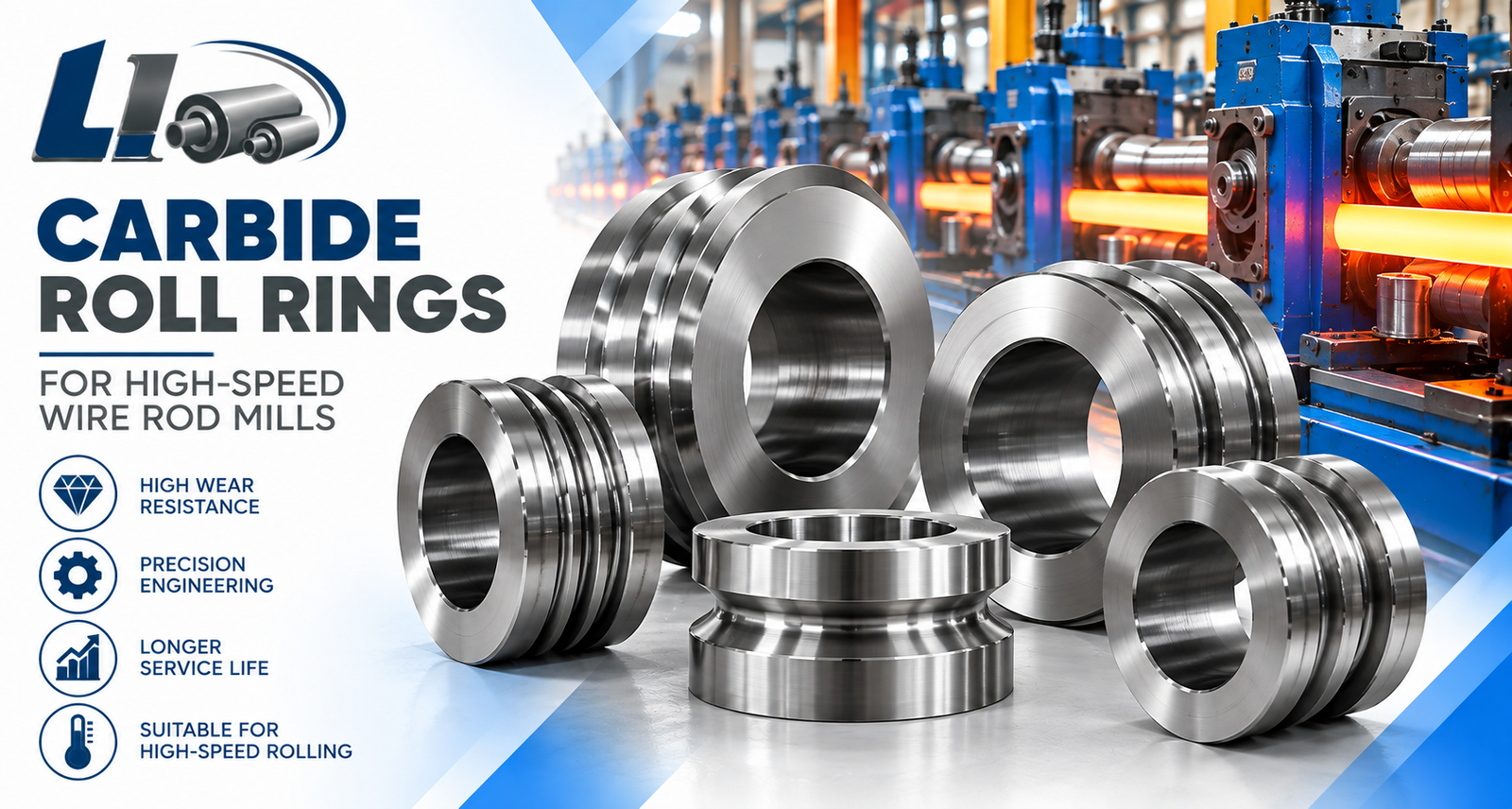
Carbide Roll Rings for High-Speed Wire Rod Mills: Selection & Buying Guide
Carbide Roll Rings for High-Speed Wire Rod Mills: Selection & Buying Guide
Carbide roll rings are specialized rolling components used in demanding wire rod mill applications where wear resistance, dimensional stability, and reliable rolling performance are important. High-speed wire rod mills place significant demands on roll components because they operate continuously at high production speeds and require consistent material reduction.
Selecting the right carbide roll rings requires more than choosing a standard size. The roll ring material, carbide grade, dimensions, pass profile, hardness, cooling conditions, rolling speed, and compatibility with the existing mill all need to be considered before purchasing.
This guide explains the important factors manufacturers should consider when selecting carbide roll rings for high-speed wire rod mills and provides practical information for buyers looking for replacement or new roll ring components.
What Are Carbide Roll Rings?
Carbide roll rings are ring-shaped rolling components manufactured using hard carbide-based materials and designed for suitable rolling mill applications. They are used where high wear resistance and dimensional stability are required during continuous rolling operations.
Unlike conventional roll materials, carbide-based rolling components can provide high resistance to abrasive and mechanical wear when correctly selected and operated within their intended application range.
The exact carbide composition, grade, geometry, and manufacturing specification should be selected according to the rolling process and equipment requirements.
Why Are Carbide Roll Rings Used in High-Speed Wire Rod Mills?
High-speed wire rod production places demanding operating conditions on rolling components. Roll rings are repeatedly exposed to contact with the material being rolled, mechanical loading, cooling cycles, and continuous production.
Suitable carbide roll rings can help maintain the required rolling geometry for longer operating periods and may reduce the frequency of component replacement when compared with less wear-resistant solutions in appropriate applications.
Key Benefits of Carbide Roll Rings
- High wear resistance for suitable rolling applications.
- Good dimensional stability during operation.
- Suitable for demanding high-speed rolling applications.
- Can help maintain pass geometry.
- Can reduce the frequency of roll ring replacement in suitable conditions.
- Supports consistent rolling performance.
- Suitable for selected finishing and high-speed rolling applications.
How to Choose the Right Carbide Roll Rings
1. Identify Your Wire Rod Mill Configuration
The first step is to understand the rolling mill configuration in which the carbide roll rings will be installed. Different stands and rolling positions can have different operating requirements.
Before ordering, provide the supplier with information such as the machine manufacturer, mill model, stand number, existing roll ring dimensions, and available technical drawings.
2. Determine the Required Roll Ring Dimensions
Correct dimensions are essential for installation and rolling performance. The replacement ring must match the existing roll assembly and mounting arrangement.
Important dimensions may include:
- Outside diameter
- Inside diameter
- Ring width
- Overall thickness
- Bore dimensions
- Mounting dimensions
- Pass profile
- Groove dimensions
Accurate dimensional information should be confirmed before manufacturing.
3. Select the Appropriate Carbide Grade
Carbide grades are not identical. Their properties can vary depending on composition, binder content, grain structure, hardness, toughness, and the intended application.
The appropriate grade should be selected according to the rolling material, rolling speed, reduction, cooling conditions, expected wear, and other operating parameters.
Instead of selecting a carbide grade solely because it has a high hardness value, buyers should consider the balance between wear resistance and toughness required for the specific application.
4. Consider Rolling Speed
High-speed wire rod mills require roll components that can operate reliably under continuous production conditions. Rolling speed can influence heat generation, wear, cooling requirements, and the mechanical demands placed on the roll ring.
When requesting carbide roll rings, provide the supplier with the operating speed and production requirements so that the component can be evaluated for the intended application.
5. Consider the Material Being Rolled
The material being processed is another important selection factor. Aluminium, copper, steel, and other materials can have different rolling characteristics and may require different component specifications.
For non-ferrous wire rod applications, the supplier should understand the material type, input dimensions, finished dimensions, rolling temperature, and production process before recommending a suitable roll ring specification.
Carbide Roll Ring Pass Profile
The pass profile is an important feature of a roll ring used in grooved rolling applications. It determines how the material is guided and reduced as it passes through the rolling stand.
The groove geometry should correspond to the production process and required finished product dimensions.
Incorrect pass dimensions can affect material flow, dimensional accuracy, and rolling stability. For replacement roll rings, an original drawing or accurate measurements of the existing component can therefore be extremely useful.
Importance of Cooling in Carbide Roll Ring Applications
Cooling is an important consideration in high-speed rolling operations. Changes in temperature can influence component performance, dimensional stability, and operating conditions.
The cooling arrangement should be suitable for the particular rolling application and should be considered when selecting the roll ring specification.
Buyers should provide information about the existing cooling system and operating conditions when discussing carbide roll ring requirements with a manufacturer.
Carbide Roll Rings vs Conventional Roll Materials
Different roll materials have different characteristics and are suitable for different applications. Carbide roll rings are generally considered where high wear resistance and dimensional stability are important.
However, the choice should be based on the specific rolling application rather than assuming that carbide is suitable for every rolling position.
Important comparison factors include:
- Wear resistance
- Toughness
- Rolling speed
- Material being processed
- Pass design
- Cooling conditions
- Expected service life
- Overall operating cost
Signs That Carbide Roll Rings May Need Replacement
Regular inspection is important for maintaining rolling mill components. Depending on the application, replacement may need to be considered when excessive wear or damage begins to affect the rolling process.
Potential signs include:
- Excessive groove wear.
- Changes in pass geometry.
- Visible cracks or damage.
- Surface deterioration.
- Dimensional inconsistency in the finished product.
- Abnormal vibration.
- Unexpected changes in rolling performance.
- Reduced production stability.
The actual cause should be established through appropriate inspection before deciding whether replacement is necessary.
How to Increase Carbide Roll Ring Service Life
Correct selection is only one part of maximizing component life. Installation, alignment, cooling, operating conditions, and maintenance can also influence performance.
- Use the correct roll ring specification.
- Ensure proper installation and alignment.
- Maintain the recommended cooling conditions.
- Avoid unsuitable operating loads.
- Inspect roll rings regularly.
- Monitor groove wear.
- Follow appropriate maintenance procedures.
- Replace damaged components promptly.
What Information Should You Provide When Ordering Carbide Roll Rings?
Providing detailed technical information helps the manufacturer evaluate the correct specification and prepare a more accurate quotation.
Ideally, provide:
- Wire rod mill manufacturer
- Mill model
- Stand number
- Roll ring drawing
- Outside diameter
- Inside diameter
- Ring width
- Pass or groove dimensions
- Material being rolled
- Rolling speed
- Production capacity
- Cooling arrangement
- Existing carbide grade, if known
- Required quantity
- Photographs of the existing roll ring
Carbide Roll Rings for Wire Rod Mills in India
Manufacturers operating wire rod mills in India may require replacement carbide roll rings for existing production equipment. When sourcing roll rings, it is important to verify the component dimensions, application requirements, manufacturing quality, and supplier’s technical capabilities.
For replacement requirements, customers can provide existing roll ring drawings, photographs, measurements, and machine details to help determine the appropriate specification.
Why Choose Laxmi Industries?
Laxmi Industries provides precision-engineered equipment and components for rolling mill and wire rod production applications. Our product range includes China Rolling Mill Rolls, Copper Rolling Mill Rolls, Rolling Mill Stands, and Rolling Mill Stand Spare Parts.
For specialized roll ring requirements, customers can share their existing component drawings, dimensions, photographs, machine information, and operating conditions for technical evaluation.
Our engineering approach focuses on application-specific specifications, dimensional accuracy, suitable materials, and reliable manufacturing for industrial rolling applications.
Frequently Asked Questions
What are carbide roll rings used for?
Carbide roll rings are used in suitable rolling mill applications where high wear resistance and dimensional stability are required. They can be particularly relevant to demanding high-speed rolling positions when the application is appropriate.
Are carbide roll rings suitable for every wire rod mill stand?
Not necessarily. The appropriate roll material depends on the stand position, material being rolled, rolling speed, pass design, cooling conditions, and other operating factors. The application should be evaluated before selecting a carbide grade.
How do I order carbide roll rings?
Provide the roll ring dimensions, pass profile, machine details, stand number, material being rolled, rolling speed, existing specifications if available, photographs, and required quantity.
Can carbide roll rings be manufactured according to an existing sample?
Depending on the application, an existing roll ring can provide useful dimensional information. Accurate measurement and engineering evaluation should be completed before final manufacturing specifications are confirmed.
What affects carbide roll ring life?
Roll ring life can be affected by material selection, carbide grade, rolling speed, rolling load, cooling, alignment, installation, pass design, maintenance, and operating conditions.
Conclusion
Selecting the right carbide roll rings for high-speed wire rod mills requires careful consideration of the rolling application, carbide grade, dimensions, pass profile, production speed, material being processed, cooling system, and equipment configuration.
A suitable roll ring should be selected according to the actual operating requirements rather than based only on hardness or purchase price. Providing detailed technical information to the manufacturer can help ensure that the component is manufactured according to the intended application.
If you are looking for carbide roll rings, wire rod mill roll rings, or other rolling mill components, contact Laxmi Industries with your drawing, dimensions, photographs, or machine details for technical evaluation and quotation.