
How to Choose the Right Wire Rod Rolling Mill for Your Factory
How to Choose the Right Wire Rod Rolling Mill for Your Factory
Choosing the right wire rod rolling mill is an important decision for manufacturers planning a new production line, expanding an existing plant, or upgrading outdated rolling equipment. A properly selected mill can support consistent production, accurate dimensions, reliable operation, and efficient use of energy and raw materials.
However, selecting a wire rod rolling mill should not be based on machine price alone. Production capacity, material type, rolling speed, mill configuration, automation, cooling requirements, maintenance, spare parts availability, and technical support all need to be considered before placing an order.
This guide explains the major factors manufacturers should evaluate when selecting a wire rod rolling mill for aluminium, copper, and other suitable non-ferrous metal applications.
What Is a Wire Rod Rolling Mill?
A wire rod rolling mill is a production system used to progressively reduce cast or semi-finished metal stock into wire rod with the required diameter, shape, surface quality, and dimensional consistency.
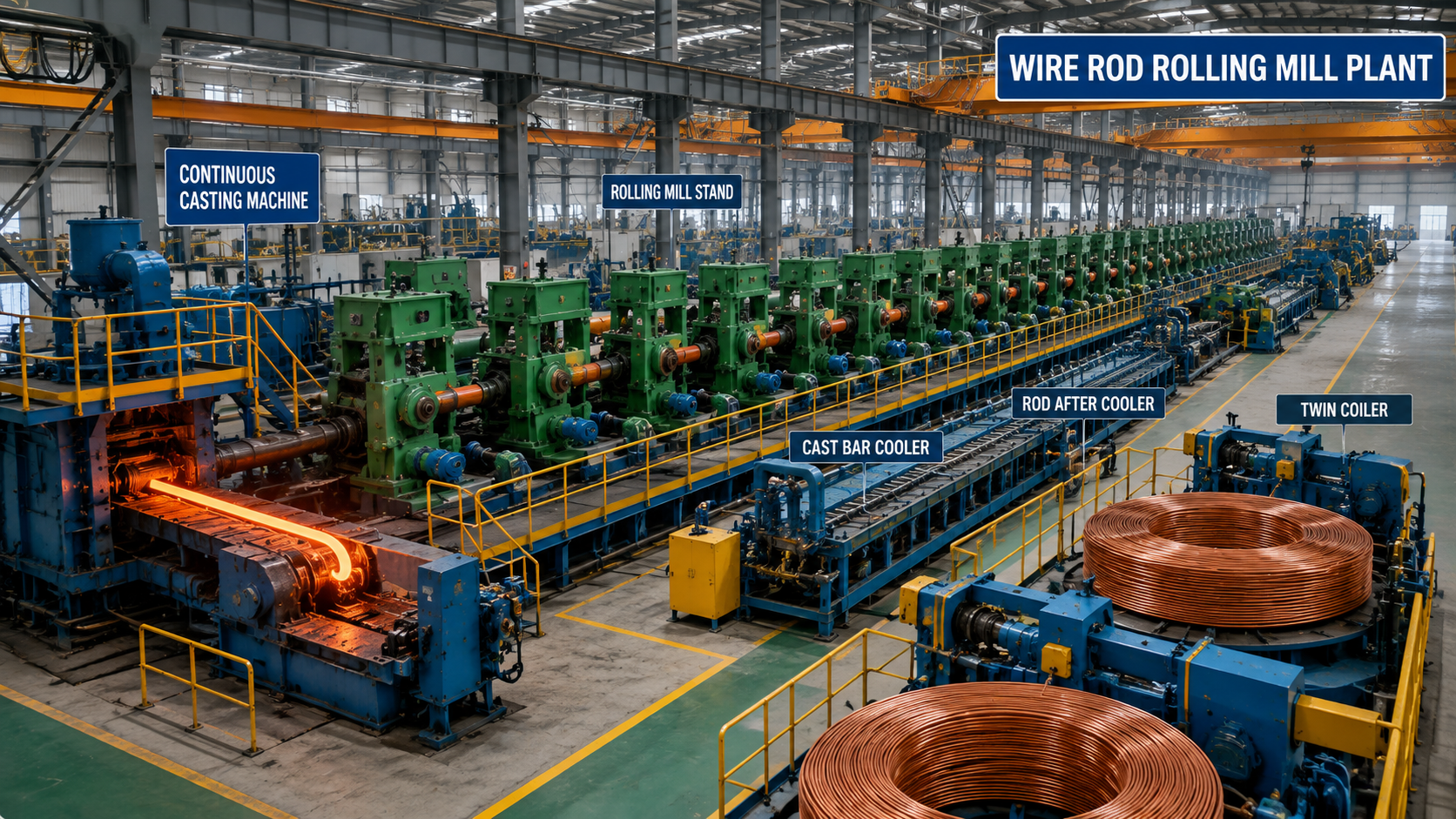
Depending on the plant configuration, a wire rod production line can include equipment such as a continuous casting machine, rolling mill stands, cooling systems, finishing equipment, coilers, and material handling systems.
The individual machines work together as a production system, which means that equipment compatibility is an important consideration when planning a new wire rod mill.
Why Proper Wire Rod Mill Selection Matters
The rolling mill is a major part of the production process. Its mechanical design, roll configuration, drive system, cooling arrangement, and automation can influence production stability and finished-product quality.
Selecting equipment according to actual production requirements can help manufacturers achieve:
- Consistent wire rod dimensions
- Stable rolling performance
- Efficient material processing
- Reduced production interruptions
- Controlled operating costs
- Improved product quality
- Better equipment utilization
- Easier maintenance and servicing
1. Determine Your Required Production Capacity
The first step when selecting a wire rod rolling mill is to define the required production capacity. The mill should be designed around the quantity of material you expect to process rather than selecting a machine based only on its maximum advertised capacity.
Consider your current production requirements as well as potential future expansion. A production line that is correctly sized for your application can provide a better balance between investment, operating costs, and production requirements.
Important factors include:
- Required tonnes per hour
- Annual production target
- Operating hours
- Expected production growth
- Required finished wire rod diameter
- Number of production shifts
2. Identify the Material You Will Roll
The material being processed is another important factor. Aluminium and copper have different processing characteristics, and the rolling system should be designed according to the material’s mechanical and thermal properties.
Before selecting equipment, provide the manufacturer with detailed information about your raw material, casting process, input dimensions, desired finished dimensions, and production requirements.
3. Select the Appropriate Rolling Mill Configuration
A wire rod rolling mill can contain multiple rolling stands arranged to progressively reduce the cross-section of the incoming material.
The number and configuration of rolling stands should be selected according to the required reduction, finished product dimensions, production speed, and overall process design.
The rolling mill stand must also provide sufficient structural rigidity to maintain stable roll positioning during operation. For more information about selecting a suitable stand and manufacturer, read our guide on How to Select the Best Rolling Mill Stand Manufacturer .
4. Consider Rolling Speed
Production speed is an important consideration when purchasing a wire rod rolling mill. Higher-speed production requires carefully coordinated equipment, accurate roll positioning, suitable cooling, reliable drive systems, and appropriate process control.
The required rolling speed should therefore be considered together with product dimensions, material characteristics, cooling requirements, and production capacity.
5. Evaluate Roll Quality
Rolls are critical wear components in a rolling mill. Their material, surface condition, dimensional accuracy, and wear resistance can affect rolling performance and maintenance requirements.
Manufacturers should consider the availability of suitable rolling mill rolls and replacement components before selecting a complete production system.
Laxmi Industries supplies solutions including China Rolling Mill Rolls and Copper Rolling Mill Rolls for applicable rolling mill requirements.
6. Check Automation and Process Control
Automation can help operators maintain consistent process parameters and coordinate different sections of a production line. Depending on the plant requirements, automation may be used for monitoring, speed coordination, temperature control, production data collection, and other process functions.
When evaluating a wire rod mill, ask the manufacturer what level of automation is included and which functions can be integrated with the existing plant control system.
7. Consider Cooling Requirements
Cooling plays an important role in maintaining appropriate operating conditions during rolling. The cooling arrangement should be matched to the material, rolling speed, production rate, and equipment configuration.
A properly designed cooling system can support stable operation and help protect critical components from excessive thermal stress.
8. Evaluate Energy Efficiency
Energy consumption is an important part of the operating cost of an industrial rolling mill. When comparing equipment, manufacturers should consider not only the initial purchase price but also the expected energy requirements during long-term operation.
Efficient motors, properly sized drives, optimized equipment configuration, suitable cooling systems, and effective process control can all contribute to responsible energy management.
9. Consider Maintenance and Spare Parts
Even well-designed industrial machinery requires regular inspection and preventive maintenance. Before purchasing a wire rod rolling mill, confirm that replacement components will be available throughout the expected operating life of the equipment.
Important spare parts can include:
- Rolling mill rolls
- Roll rings
- Bearings
- Couplings
- Drive components
- Sealing components
- Fasteners
- Other machine-specific components
Reliable access to rolling mill stand spare parts can help reduce unnecessary production delays when maintenance or component replacement is required.
10. Check the Manufacturer’s Engineering Capability
The supplier’s engineering capability is just as important as the machine itself. A manufacturer should be able to understand your production requirements and develop equipment around the application rather than simply supplying a standard machine.
Before selecting a supplier, consider:
- Engineering and design capabilities
- Manufacturing facilities
- Quality inspection procedures
- Customization capabilities
- Previous industrial experience
- Installation and commissioning support
- Availability of spare parts
- Technical assistance
11. Do Not Compare Suppliers Only by Machine Price
The lowest initial quotation does not necessarily represent the lowest total cost of ownership. Buyers should evaluate the complete value of the equipment over its operating life.
A proper comparison should consider:
- Initial equipment cost
- Installation requirements
- Energy consumption
- Maintenance requirements
- Component service life
- Spare parts cost
- Technical support
- Expected production performance
Looking at the total cost of ownership provides a more useful basis for comparing different wire rod mill solutions.
12. Ask the Manufacturer for a Detailed Technical Proposal
Before placing an order, request a detailed technical proposal rather than evaluating a quotation based only on a single price figure.
The proposal should clearly describe the proposed equipment, production assumptions, machine configuration, utilities, scope of supply, automation, installation requirements, commissioning responsibilities, spare parts, and after-sales support.
Questions to Ask a Wire Rod Mill Manufacturer
- What production capacity can the proposed mill achieve?
- What materials is the mill designed to process?
- What finished wire rod sizes can be produced?
- How many rolling stands are included?
- What type of rolls are recommended?
- What automation and control systems are available?
- What cooling system is required?
- Which spare parts are supplied?
- What maintenance support is available?
- Can the system be customized for our plant?
- What information is required to prepare a technical proposal?
Wire Rod Mill Buying Checklist
Before making a final purchasing decision, use the following checklist:
- Define production capacity.
- Specify the raw material.
- Define input and finished dimensions.
- Determine the required rolling speed.
- Review the rolling mill configuration.
- Evaluate roll and component quality.
- Check automation requirements.
- Review cooling requirements.
- Estimate long-term energy consumption.
- Confirm spare parts availability.
- Evaluate technical support.
- Compare the total cost of ownership.
- Request a detailed technical proposal.
Why Choose Laxmi Industries for Rolling Mill Equipment?
Laxmi Industries provides precision-engineered equipment and components for rolling mill and wire rod production applications. Our product range includes Continuous Casting Machines , Rolling Mill Stands , Copper Rolling Mill Rolls , China Rolling Mill Rolls , and Rolling Mill Stand Spare Parts .
Our solutions are developed for demanding industrial environments where reliability, precision, maintainability, and consistent production are important considerations. Depending on the application, equipment can be selected and configured according to production requirements and plant conditions.
Conclusion
Choosing the right wire rod rolling mill requires careful evaluation of production capacity, material type, rolling speed, mill configuration, automation, cooling, energy consumption, maintenance, spare parts, and supplier capabilities.
Instead of comparing machines only by their purchase price, manufacturers should evaluate the complete production solution and its expected long-term operating requirements. A detailed technical discussion with an experienced rolling mill equipment manufacturer can help ensure that the selected system matches the factory’s production goals and future requirements.
If you are planning a new wire rod production line, upgrading an existing rolling mill, or looking for individual rolling mill equipment and components, Laxmi Industries can provide engineering solutions for your specific application.