
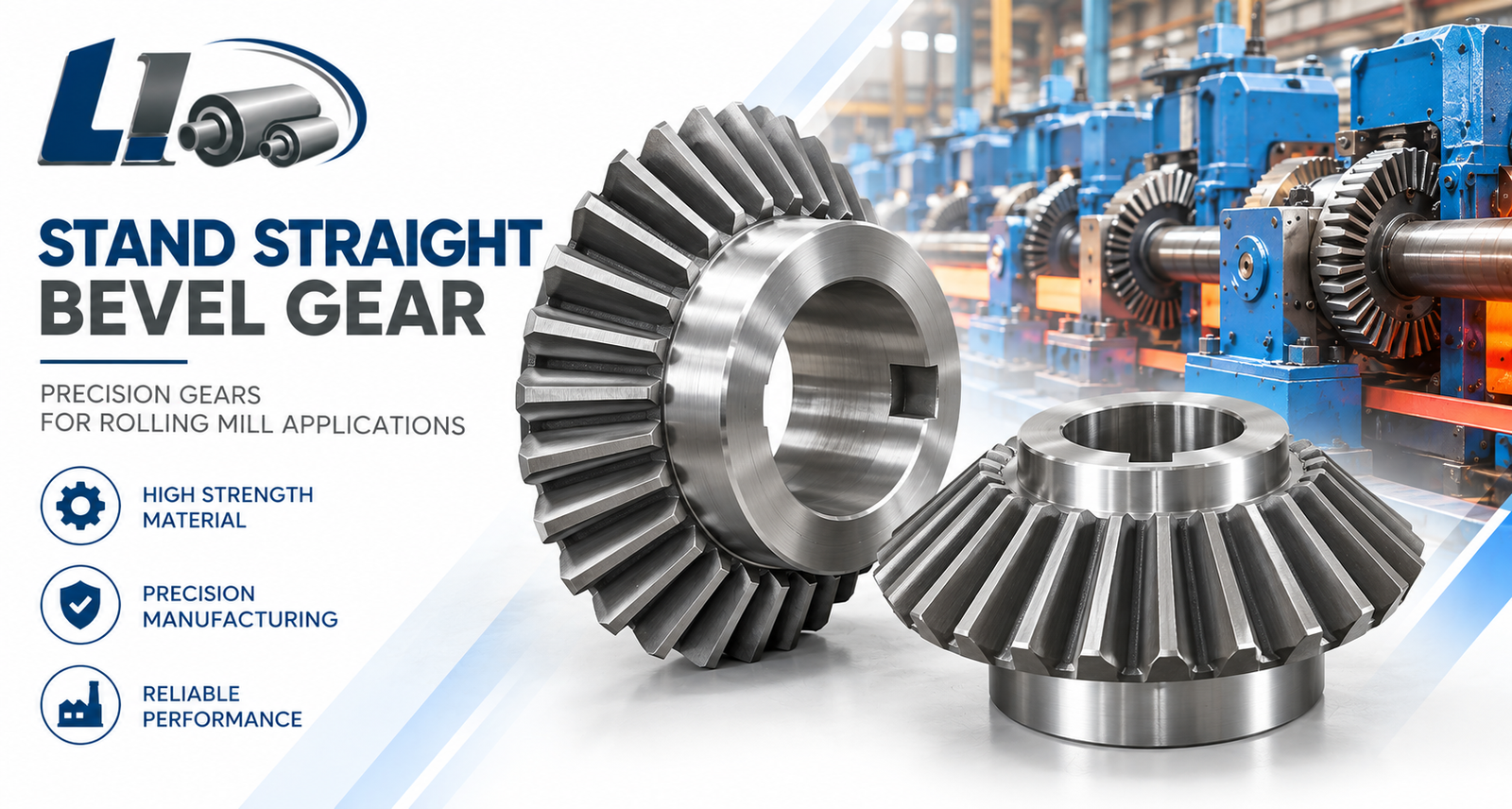
Stand Straight Bevel Gear for Rolling Mills: Selection & Replacement Guide
Stand Straight Bevel Gear for Rolling Mills: Selection & Replacement Guide
A Stand Straight Bevel Gear is an important mechanical transmission component used in suitable rolling mill stand assemblies. Bevel gears allow rotational power to be transferred between shafts positioned at an angle, making them useful in specific drive and transmission arrangements used in industrial rolling equipment.
Rolling mill gears operate under demanding conditions involving continuous rotation, mechanical loading, vibration, and repeated production cycles. Selecting a correctly manufactured replacement bevel gear is therefore important for maintaining proper mechanical operation and compatibility with the existing rolling mill assembly.
This guide explains the role of stand straight bevel gears, the important specifications to consider, common signs of gear wear, and what information should be provided when ordering a replacement gear for a rolling mill.
What Is a Stand Straight Bevel Gear?
A straight bevel gear is a gear with teeth arranged on a conical surface. It is designed to transmit rotational motion between intersecting shafts and can be used in mechanical drive systems where the direction of rotation needs to change.
In a rolling mill stand application, the exact gear design depends on the equipment configuration, shaft arrangement, transmission requirements, gear ratio, dimensions, and operating conditions.
Why Are Bevel Gears Used in Rolling Mills?
Rolling mill equipment contains several rotating and driven components that need to operate in a coordinated manner. Depending on the mechanical design, bevel gears can be used to transmit power between shafts and provide the required direction of rotation.
A correctly specified gear helps maintain compatibility with the existing transmission system and supports reliable operation of the associated rolling mill equipment.
Important Specifications of a Stand Straight Bevel Gear
A replacement bevel gear should be manufactured according to the requirements of the existing equipment. Important specifications can include:
- Number of teeth
- Module
- Pressure angle
- Pitch diameter
- Outside diameter
- Face width
- Bore diameter
- Shaft dimensions
- Keyway dimensions
- Gear ratio
- Mounting arrangement
- Material specification
- Required hardness
The exact specifications should be confirmed from an original drawing, gear data, equipment documentation, or accurate inspection of the existing component.
How to Choose the Right Stand Straight Bevel Gear
1. Identify the Rolling Mill Stand
The first step is to identify the rolling mill stand in which the gear is installed. Machine manufacturer, equipment model, stand number, and existing gear information can help the supplier determine the intended application.
Avoid ordering a replacement gear based only on its general appearance. Similar-looking gears can have different tooth profiles, dimensions, ratios, and mounting arrangements.
2. Check the Number of Teeth
The number of teeth is one of the fundamental specifications of a bevel gear. It influences the gear ratio and must match the corresponding mating gear in the transmission system.
When replacing an existing gear, the tooth count should be verified carefully before manufacturing.
3. Verify the Module and Gear Geometry
The module and tooth geometry must be compatible with the mating gear. Using an incorrect gear geometry can result in improper tooth engagement and may affect the operation of the transmission system.
For this reason, gear drawings or accurate gear measurements should be provided whenever available.
4. Check Bore and Shaft Dimensions
The gear must fit correctly onto the shaft or mounting arrangement for which it is intended. Bore diameter, shaft diameter, keyway dimensions, and other mounting features should therefore be confirmed before ordering.
5. Select the Appropriate Material
The material used for a bevel gear should be selected according to the mechanical load, operating conditions, gear size, production requirements, and expected service conditions.
Suitable alloy steels and other engineering materials may be considered depending on the application. The final material specification should be determined through appropriate engineering evaluation.
6. Consider Gear Hardness
Hardness can influence wear resistance and the service life of gear teeth. The required hardness depends on the gear material, loading conditions, operating speed, lubrication, and overall transmission design.
The replacement gear should be manufactured according to the required engineering specification rather than using a generic hardness value.
Why Gear Machining Accuracy Matters
Precision machining is important for rolling mill gears because the gear must work correctly with its mating component. Dimensional errors or unsuitable tooth geometry can affect gear engagement and mechanical operation.
Important manufacturing and inspection considerations can include:
- Tooth profile accuracy
- Tooth spacing
- Concentricity
- Bore accuracy
- Keyway accuracy
- Face width
- Pitch dimensions
- Runout
- Surface finish
Common Signs of a Worn Bevel Gear
Regular inspection can help identify gear problems before they result in unexpected equipment interruptions.
Potential signs of gear wear or damage include:
- Unusual gear noise
- Excessive vibration
- Visible tooth wear
- Damaged or chipped teeth
- Abnormal backlash
- Irregular tooth contact
- Overheating around the transmission
- Unexpected changes in mechanical operation
- Repeated transmission problems
The actual cause should be established through appropriate inspection before deciding whether the gear needs replacement.
What Causes Bevel Gear Wear?
Gear service life depends on several operating and maintenance factors. Potential causes of premature wear can include excessive mechanical loading, inadequate lubrication, misalignment, contamination, incorrect gear engagement, improper installation, and unsuitable operating conditions.
Correct installation and regular inspection are therefore important parts of rolling mill maintenance.
How to Order a Replacement Stand Straight Bevel Gear
When requesting a quotation for a replacement bevel gear, provide as much technical information as possible.
- Machine manufacturer
- Rolling mill model
- Stand number
- Original gear part number
- Gear drawing
- Number of teeth
- Module
- Pressure angle
- Gear diameter
- Face width
- Bore diameter
- Keyway dimensions
- Material specification
- Required quantity
- Photographs of the existing gear
Providing an original drawing is particularly useful because it can contain important dimensions and tolerances that may not be possible to determine accurately from photographs alone.
Can a Stand Straight Bevel Gear Be Custom Manufactured?
Replacement bevel gears can be evaluated for custom manufacturing when the required engineering information is available. This can be useful for older rolling mills where the original component is difficult to source or when a replacement gear is required according to a specific machine configuration.
An existing gear, technical drawing, dimensional measurements, and equipment information can help a manufacturer evaluate the replacement requirement.
The final design and manufacturing specifications should be verified before production to ensure compatibility with the existing transmission system.
Maintenance Tips for Rolling Mill Bevel Gears
- Inspect gear teeth regularly.
- Maintain the recommended lubrication system.
- Check for abnormal vibration.
- Monitor unusual transmission noise.
- Inspect gear alignment.
- Check for excessive backlash.
- Keep the gear assembly free from contamination.
- Follow the equipment manufacturer’s maintenance recommendations.
Stand Straight Bevel Gear as a Rolling Mill Spare Part
A stand straight bevel gear is one of many specialized components that may be required during rolling mill maintenance and refurbishment. Depending on the equipment design, other spare parts may include rolling mill rolls, bearing housings, shafts, guides, couplings, roll rings, and other mechanical components.
Laxmi Industries provides Rolling Mill Stand Spare Parts for applicable industrial requirements and can evaluate replacement components based on drawings, photographs, dimensions, and machine details.
Other Rolling Mill Components
Modern rolling mill equipment consists of multiple interconnected mechanical components. Maintaining the availability of critical replacement parts can help maintenance teams plan repairs and equipment refurbishment more effectively.
Our product range includes China Rolling Mill Rolls, Copper Rolling Mill Rolls, Rolling Mill Stands, Continuous Casting Machines, bearing housings, guides, gears, and other rolling mill components.
Why Choose Laxmi Industries?
Laxmi Industries provides precision-engineered equipment and components for rolling mill and wire rod production applications. Our engineering approach focuses on suitable materials, accurate dimensions, precision machining, and inspection of critical component features.
For replacement gear requirements, customers can provide an existing gear, technical drawing, photographs, dimensions, or machine information for evaluation. This information helps determine the appropriate specifications before manufacturing.
Frequently Asked Questions
What is a stand straight bevel gear?
A stand straight bevel gear is a bevel gear used in a suitable rolling mill stand transmission arrangement to transfer rotational power between intersecting shafts. Its exact design depends on the machine configuration.
How do I identify the correct rolling mill bevel gear?
Verify the number of teeth, module, pressure angle, pitch dimensions, bore, keyway, face width, material, and other relevant specifications. The original drawing or gear identification information is particularly useful.
Can a replacement bevel gear be manufactured from a sample?
Depending on the component, an existing gear can provide useful information for replacement manufacturing. Accurate measurements and engineering inspection are recommended before confirming the final specifications.
What information should I provide for a quotation?
Provide the machine model, stand number, gear drawing if available, dimensions, tooth count, module, photographs, material information, and required quantity.
Conclusion
Selecting the correct Stand Straight Bevel Gear requires careful consideration of gear geometry, dimensions, material, hardness, shaft compatibility, mounting arrangement, and operating conditions. Because the gear works as part of a larger transmission system, compatibility with the mating gear and existing rolling mill assembly is particularly important.
For replacement requirements, providing accurate technical information allows the manufacturer to evaluate the component and determine the appropriate manufacturing specifications. This can help reduce compatibility issues and support reliable rolling mill operation.
If you require a stand straight bevel gear, rolling mill bevel gear, or other rolling mill spare parts, contact Laxmi Industries with your drawing, dimensions, photographs, or machine details for technical evaluation and quotation.