
Complete Guide to Wire Rod Rolling Mills: Process, Components and Benefits
Complete Guide to Wire Rod Rolling Mills: Process, Components and Benefits
The Wire Rod Rolling Mill plays a crucial role in the manufacturing of aluminium and copper wire rods used in electrical cables, conductors, automotive components, transformers, and various industrial applications. Modern rolling mills combine advanced engineering with automated production systems to deliver superior quality wire rods with exceptional dimensional accuracy and high production efficiency.
In this comprehensive guide, we explain how wire rod rolling mills work, their major components, production process, advantages, and the factors to consider when selecting the right rolling mill for your manufacturing requirements.
What is a Wire Rod Rolling Mill?
A Wire Rod Rolling Mill is an industrial production system designed to reduce the cross-sectional area of hot metal through a series of precision rolling stands. The process converts cast bars into high-quality wire rods having uniform dimensions, smooth surface finish, and excellent mechanical properties.
These rolling mills are commonly used for processing Aluminium, Copper, Brass, and other non-ferrous metals where high production speed and consistent quality are essential.
How Does a Wire Rod Rolling Mill Work?
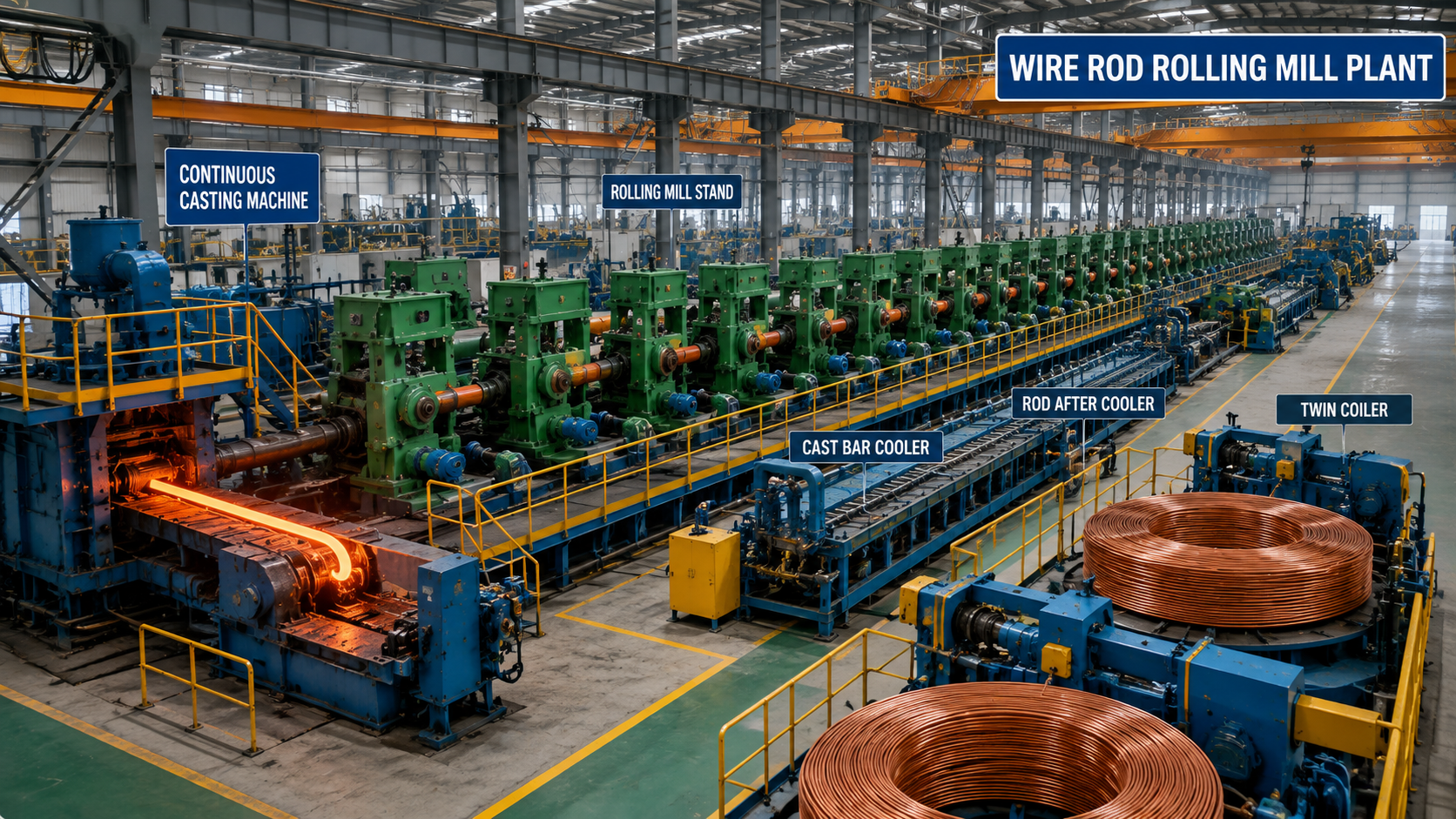
The manufacturing process begins with a Continuous Casting Machine where molten metal is transformed into cast bars. These cast bars are then straightened, cut, cooled, and fed into multiple rolling stands where their diameter is gradually reduced through several rolling passes.
After rolling, the wire rod passes through cooling systems and is finally collected using high-speed Twin Coilers, producing compact coils ready for further processing.
Main Components of a Wire Rod Rolling Mill
- Continuous Casting Machine
- Cast Bar Straightener
- Cast Bar Cutter
- Tilter Rod Feeder
- Rolling Mill Stand
- Rolling Mill Rolls
- Cast Bar Cooler
- Rod After Cooler
- Coiler Traverse
- Twin Coilers
- Casting Ring Mould
Benefits of Modern Rolling Mills
- High production efficiency
- Excellent dimensional accuracy
- Superior surface finish
- Reduced energy consumption
- Low maintenance costs
- Long equipment life
- Stable continuous production
- Reduced material wastage
- Higher product consistency
- Lower operating costs
Industries Using Wire Rod Rolling Mills
- Electrical Cable Manufacturers
- Copper Processing Plants
- Aluminium Industries
- Transformer Manufacturers
- Conductor Manufacturers
- Wire Drawing Plants
- Engineering Industries
- Metal Processing Plants
Why Rolling Mill Quality Matters
Selecting premium-quality rolling mill machinery directly impacts production capacity, product quality, operational efficiency, and maintenance costs. Precision-engineered equipment minimizes downtime while delivering consistent wire rod dimensions throughout continuous production.
High-quality components such as Rolling Mill Rolls, Rolling Mill Stands, Casting Ring Moulds, and Twin Coilers contribute significantly to increasing equipment life and reducing overall production expenses.
Choosing the Right Manufacturer
When investing in rolling mill equipment, manufacturers should consider engineering expertise, product quality, after-sales support, customization capabilities, and the availability of spare parts. A reliable supplier ensures long-term performance and uninterrupted plant operations.
Why Choose Laxmi Industries?
Laxmi Industries specializes in manufacturing advanced Rolling Mill Machinery, Continuous Casting Machines, Rolling Mill Rolls, Twin Coilers, Rolling Mill Stand Spare Parts, and complete solutions for Aluminium and Copper Wire Rod Manufacturing Plants. Every product is engineered to deliver maximum productivity, superior durability, and dependable performance in modern industrial environments.
Conclusion
Modern Wire Rod Rolling Mills are essential for producing high-quality Aluminium and Copper wire rods efficiently and economically. Investing in precision-engineered machinery not only improves production quality but also reduces maintenance costs and increases long-term profitability.