

How to Estimate Wire Rod Mill Production Capacity
When planning a new wire rod line or evaluating an existing one, manufacturers need to understand production capacity. Capacity depends on rod size, rolling speed, metal type, and how many hours the mill actually runs. A basic calculation provides a useful estimate, while real-world factors determine actual output.
The Basic Principle
In a continuous rolling mill, the mass of metal leaving the final stand per unit of time equals the rod’s cross-sectional area multiplied by its speed and the density of the metal.
Hourly output = cross-sectional area × finishing speed × metal density × time
Step-by-Step Estimate
Step 1: Find the Cross-Sectional Area
For round rod, area = π × (diameter ÷ 2)².
Step 2: Use the Finishing Speed
The speed of the rod leaving the final stand, usually expressed in metres per second.
Step 3: Apply Metal Density
Copper is considerably denser than aluminium, so the same rod size and speed produce a greater mass of copper per hour.
Step 4: Convert to Hourly Output
Multiply area, speed, density, and the number of seconds in an hour, taking care to keep units consistent.
Why Actual Output Is Lower Than Theoretical
Operating Hours
Planned maintenance, roll changes, and shift patterns reduce available hours.
Unplanned Stoppages
Cobbles, breakdowns, and casting problems reduce output.
Start-Up and Scrap
Material cut during start-up and defects is not counted as good production.
Casting Capacity
In a continuous line, rolling output cannot exceed what the casting machine supplies.
Coiling and Handling
Coiler capacity and coil handling can limit output if not matched to the mill.
Measuring Real Performance
Track good tonnage produced compared with the theoretical capacity for the hours available. This shows how much output is lost and where improvements can be made.
Balancing the Line
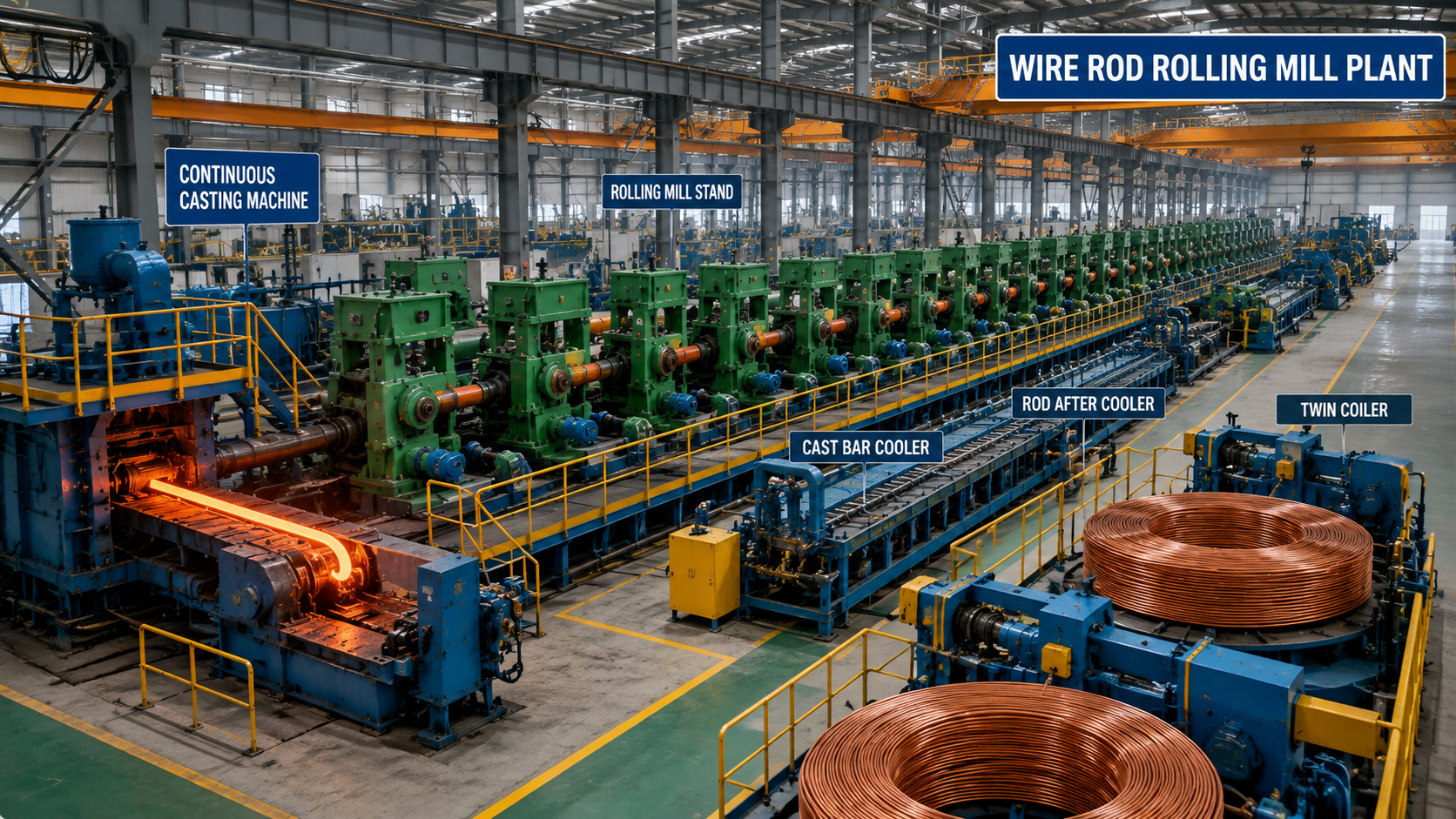
For maximum output, each section must be matched:
- Continuous Casting Machine capacity
- Bar preparation equipment
- Wire Rod Rolling Mill speed and stands
- Rod After Cooler capacity
- Twin Coilers and coil handling
Planning a New Line
When specifying a new line, define the required annual tonnage, expected working hours, and product mix. The supplier can then configure the line accordingly.
Understanding Utilisation and Efficiency
Two useful ideas help explain the gap between theoretical and actual output:
- Utilisation: the share of available time that the mill is actually running
- Efficiency: how close the mill runs to its rated speed while operating
- Yield: the share of material that becomes good, saleable rod
Multiplying these factors together gives a clear picture of overall effectiveness. Improving any one of them increases actual output.
Estimating Annual Capacity
Annual capacity depends on the number of operating days, shifts per day, and expected utilisation. For planning, many manufacturers estimate:
- Total calendar hours in the year
- Minus planned maintenance and holidays
- Minus expected unplanned downtime
- Multiplied by the average hourly output
This gives a more realistic annual tonnage than the theoretical maximum.
How Product Mix Affects Output
If a mill produces several rod sizes, its average hourly output depends on how much of each size is produced. Larger sizes may deliver more tonnes per hour at a given finishing speed, while smaller sizes may run at higher speeds but carry less metal per metre. Planning production schedules with this in mind helps maximise total output.
Identifying the Bottleneck
In any production line, one section limits the total output. This may be the furnace, the casting machine, the rolling mill, or the coilers. Increasing capacity in other sections will not raise total output until the bottleneck is addressed. Measuring the capability of each section helps identify where investment will have the most effect.
Capacity Planning for Growth
When demand is expected to grow, consider:
- Whether the current line can run more hours
- Whether downtime can be reduced
- Whether speed can be increased safely
- Which section would become the next bottleneck
- Whether a second line would be more effective
Keeping Capacity Records
Recording daily output, running hours, and stoppages allows managers to track performance against capacity. Over time, these records show whether improvement efforts are working and support better planning decisions.
Why Choose Laxmi Industries?
Laxmi Industries designs Continuous Casting Machines and Wire Rod Rolling Mills around the customer’s metal, output, and layout, helping balance the line for the required capacity.
Frequently Asked Questions
How is rolling mill capacity calculated?
By multiplying the rod cross-sectional area, finishing speed, metal density, and time.
Why does my mill produce less than its rated capacity?
Stoppages, roll changes, scrap, and limits in casting or coiling reduce actual output.
Does rod size affect capacity?
Yes. Larger rod sizes carry more metal per metre, affecting hourly output at a given speed.
Can I increase capacity without a new mill?
Reducing downtime and balancing line sections can increase output.
Conclusion
A simple calculation gives a theoretical capacity, but real output depends on uptime, scrap, and how well each line section is matched. Understanding both helps manufacturers plan investments and improve performance.
Contact Laxmi Industries with your capacity and rod size requirements to discuss a suitable casting and rolling line.
