

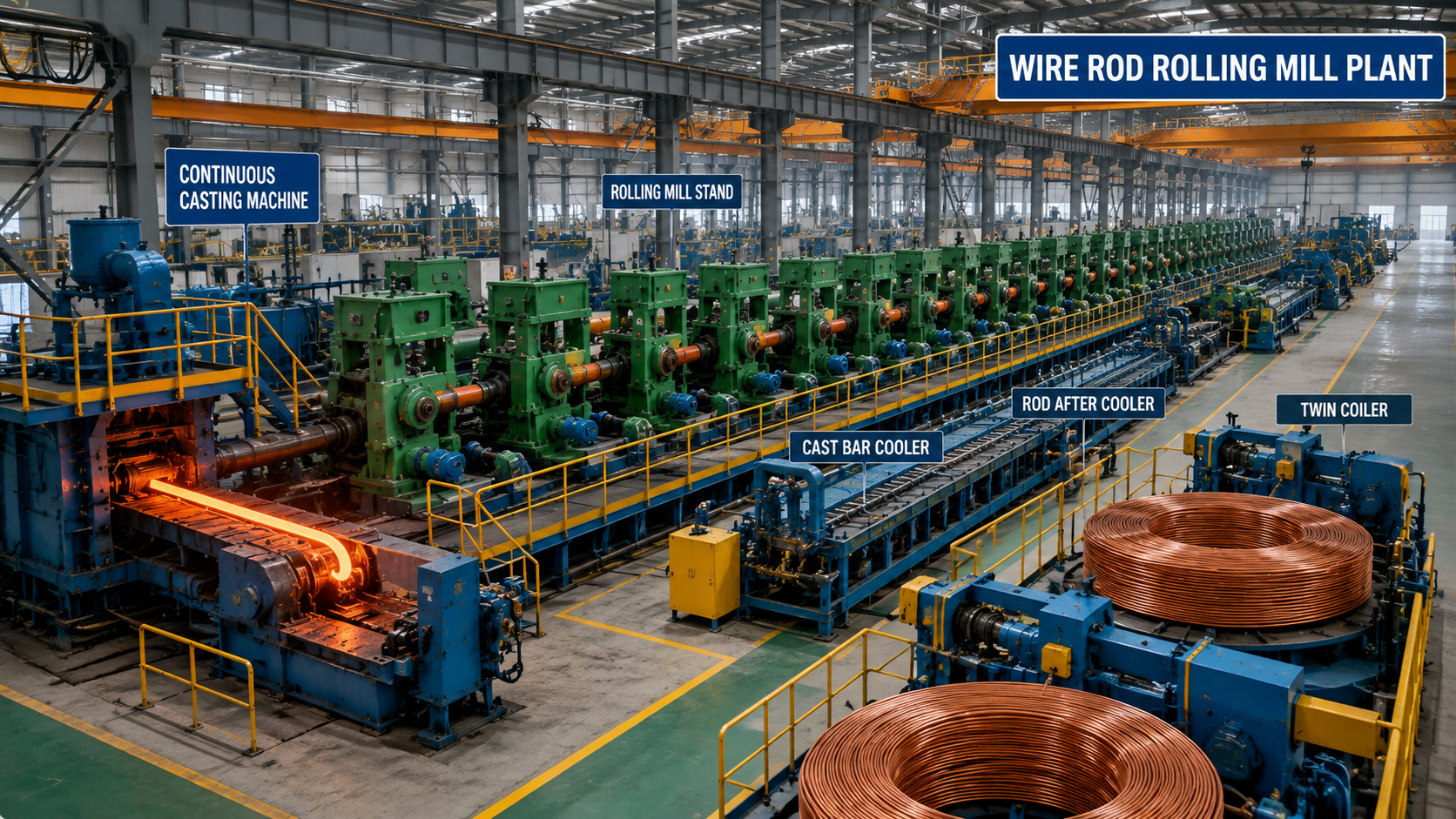
Aluminium vs Copper Wire Rod Lines: Key Differences in Equipment and Process
Both aluminium and copper wire rod are commonly produced by continuous casting and rolling. The overall layout of the two lines looks similar, but the metals behave differently, so equipment and process settings must be chosen carefully. Understanding these differences helps manufacturers plan new lines or evaluate upgrades.
Similarities Between the Two Lines
- Melting and holding of metal
- Continuous casting into a bar
- Straightening and preparation of the bar
- Rolling through multiple stands
- Cooling of the finished rod
- Coiling
Key Differences
1. Melting Temperature
Copper melts at a significantly higher temperature than aluminium. Furnaces, refractories, launders, and casting equipment must be designed for the metal being processed.
2. Thermal Properties
The two metals conduct and store heat differently. This affects how quickly the bar solidifies, how much cooling is needed, and how temperature changes through the line.
3. Oxidation Behaviour
Hot copper oxidises readily in air, so copper lines often include surface protection or oxide reduction in the cooling section. Aluminium forms a thin natural oxide layer and is handled differently.
4. Rolling Behaviour
Copper and aluminium respond differently to deformation. Pass design, roll speeds, and loads are set according to the metal.
5. Roll and Guide Requirements
Contact parts must suit the metal to avoid sticking, pick-up, or surface marking. Roll materials and surface finishes may differ.
6. Cooling and Surface Treatment
The Rod After Cooler design reflects the surface quality needs of each metal.
What These Differences Mean for Equipment
Casting Machine
The Continuous Casting Machine, Casting Ring Mould, and cooling arrangement must be designed for the metal’s temperature and solidification behaviour.
Rolling Mill
The Wire Rod Rolling Mill stand sequence, pass design, and drive capacity depend on the metal and rod size range.
Rolls
Copper lines use rolls suited to copper, such as Rolls for Copper Rolling Mill. Roll selection should match the metal and stand position.
Auxiliary Equipment
Straighteners, cutters, and coilers must handle each metal’s characteristics at its operating temperature.
Can One Line Process Both Metals?
Some equipment designs may be adaptable, but a line built for one metal is generally optimised for it. Switching metals usually requires changes to casting, rolling, and cooling arrangements. Manufacturers should evaluate this carefully at the planning stage.
Planning Considerations
- Metal and grades to be produced
- Capacity and rod size range
- Furnace and casting design
- Rolling mill configuration
- Cooling and surface treatment needs
- Utilities and plant layout
Comparing the Lines Section by Section
It can help to look at each section of the line and consider how the metal changes what is needed.
Melting and Holding
Copper requires furnaces and refractories designed for higher temperatures. Aluminium melting focuses strongly on melt cleanliness and dross control.
Casting
Both metals are commonly cast on wheel-type machines, but cooling intensity, casting speed, and ring design are set differently for each.
Bar Preparation
Straighteners, cutters, and feeders must be designed for the bar section, temperature, and strength of each metal.
Rolling
Pass design, roll speeds, and roll materials differ. Rolls and guides must suit the metal’s surface behaviour.
Cooling
Copper lines often combine cooling with oxide control. Aluminium lines focus on controlled cooling for handling and properties.
Coiling
Coil formation must suit each metal’s stiffness and handling characteristics.
Spare Parts Differences
Because equipment is designed for each metal, spare parts are often specific to the line. Rolls, guides, and casting rings in particular should be ordered for the correct metal and stand. Mixing parts between copper and aluminium lines can lead to quality problems.
Utility Requirements
Copper lines generally need more energy for melting because of copper’s higher melting temperature. Both lines need reliable cooling water, compressed air, and electrical supply. Utility capacity should be confirmed for the metal and capacity planned.
Market and Product Considerations
The choice between copper and aluminium rod production is usually driven by market demand, customer base, raw material availability, and investment budget. Some manufacturers operate separate lines for each metal to serve different markets.
Questions to Ask Before Choosing
- Which metal does your target market demand?
- What grades and rod sizes will you produce?
- What raw material sources are available?
- What utilities can your site provide?
- Do you plan to add a second metal in future?
Answering these questions early helps define the right line configuration.
Why Choose Laxmi Industries?
Laxmi Industries manufactures casting and rolling equipment for both aluminium and copper wire rod, including Continuous Casting Machines, Wire Rod Rolling Mills, Copper Rolling Mill Rolls, and Rod After Coolers.
Each line is configured for the metal, capacity, and product requirements.
Frequently Asked Questions
Are aluminium and copper rod lines the same?
They follow a similar sequence, but equipment and settings differ because of the metals’ temperatures, thermal properties, and oxidation behaviour.
Why do copper lines need surface treatment?
Hot copper oxidises quickly, so cooling and oxide control help achieve a clean rod surface.
Can I convert an aluminium line to copper?
Conversion usually requires significant changes and should be evaluated carefully.
Do the rolls differ between metals?
Roll material and finish are selected according to the metal and stand position.
Conclusion
Aluminium and copper rod lines share the same basic process, but the details differ in important ways. Matching every section of the line to the metal helps achieve stable production and consistent rod quality.
Contact Laxmi Industries with your metal, capacity, and rod size requirements to discuss the right line configuration.
